|

DNA is made up of several repeating units. In chemistry, this is termed a polymer. Each unit, or nucleotide consists of a phosphate group, a sugar (deoxyribose) and one base - either adenine, guanine, cytosine, or thymine, abbreviated as A, G, C, and T.
In the following diagrams, Carbon is represented as the red sphere, Nitrogen as green, Oxygen as blue and Hydrogen as grey.
Each carbon on the deoxyribose molecule is labelled with a number from one to five. C1 is the first carbon to the right of the top oxygen. The labelling proceeds clockwise with C5 being the upper left carbon atom.
| Deoxyribose |  |
Thymine and Cytosine have a single ring structure and are called pyrimidines.
| Thymine | 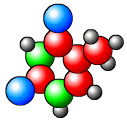 | 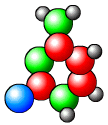 | Cytosine |
Adenine and Guanine have a double ring structure and are called purines.
| Adenine | 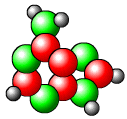 | 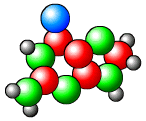 | Guanine |
When a source of DNA is broken down, it always yields the same number of molecules of cytosine and guanine, and the same number of molecules of adenine and thymine (number of A equals number of T, and number of G equals number of C). These base ratios are
known as Chargaff’s Rule. Thus it shows that the base Adenine joins only joins to the base Thymine, and the base Guanine joins to the base Cytosine.
|

